Monday, June 8, 2009

Debunking Canadian Health Care Myths

.....

Rhonda Hackett
Jun 7, 2009 - Denver Post

.....

What do we pay for, anyway? As a Canadian living in the United States for the past 17 years, I am frequently asked by Americans and Canadians alike to declare one health care system as the better one.

Often I'll avoid answering, regardless of the questioner's nationality. To choose one or the other system usually translates into a heated discussion of each one's merits, pitfalls, and an intense recitation of commonly cited statistical comparisons of the two systems.

Because if the only way we compared the two systems was with statistics, there is a clear victor. It is becoming increasingly more difficult to dispute the fact that Canada spends less money on health care to get better outcomes.

Yet, the debate rages on. Indeed, it has reached a fever pitch since President Barack Obama took office, with Americans either dreading or hoping for the dawn of a single-payer health care system. Opponents of such a system cite Canada as the best example of what not to do, while proponents laud that very same Canadian system as the answer to all of America's health care problems. Frankly, both sides often get things wrong when trotting out Canada to further their respective arguments.

As America comes to grips with the reality that changes are desperately needed within its health care infrastructure, it might prove useful to first debunk some myths about the Canadian system.

* Myth: Taxes in Canada are extremely high, mostly because of national health care.

In actuality, taxes are nearly equal on both sides of the border. Overall, Canada's taxes are slightly higher than those in the U.S. However, Canadians are afforded many benefits for their tax dollars, even beyond health care (e.g., tax credits, family allowance, cheaper higher education), so the end result is a wash. At the end of the day, the average after-tax income of Canadian workers is equal to about 82 percent of their gross pay. In the U.S., that average is 81.9 percent.

* Myth: Canada's health care system is a cumbersome bureaucracy.

The U.S. has the most bureaucratic health care system in the world. More than 31 percent of every dollar spent on health care in the U.S. goes to paperwork, overhead, CEO salaries, profits, etc. The provincial single-payer system in Canada operates with just a 1 percent overhead. Think about it. It is not necessary to spend a huge amount of money to decide who gets care and who doesn't when everybody is covered.

* Myth: The Canadian system is significantly more expensive than that of the U.S.

Ten percent of Canada's GDP is spent on health care for 100 percent of the population. The U.S. spends 17 percent of its GDP but 15 percent of its population has no coverage whatsoever and millions of others have inadequate coverage. In essence, the U.S. system is considerably more expensive than Canada's. Part of the reason for this is uninsured and underinsured people in the U.S. still get sick and eventually seek care. People who cannot afford care wait until advanced stages of an illness to see a doctor and then do so through emergency rooms, which cost considerably more than primary care services.

What the American taxpayer may not realize is that such care costs about $45 billion per year, and someone has to pay it. This is why insurance premiums increase every year for insured patients while co-pays and deductibles also rise rapidly.

* Myth: Canada's government decides who gets health care and when they get it.

While HMOs and other private medical insurers in the U.S. do indeed make such decisions, the only people in Canada to do so are physicians. In Canada, the government has absolutely no say in who gets care or how they get it. Medical decisions are left entirely up to doctors, as they should be.

There are no requirements for pre-authorization whatsoever. If your family doctor says you need an MRI, you get one. In the U.S., if an insurance administrator says you are not getting an MRI, you don't get one no matter what your doctor thinks — unless, of course, you have the money to cover the cost.

* Myth: There are long waits for care, which compromise access to care.There are no waits for urgent or primary care in Canada.

There are reasonable waits for most specialists' care, and much longer waits for elective surgery. Yes, there are those instances where a patient can wait up to a month for radiation therapy for breast cancer or prostate cancer, for example. However, the wait has nothing to do with money per se, but everything to do with the lack of radiation therapists. Despite such waits, however, it is noteworthy that Canada boasts lower incident and mortality rates than the U.S. for all cancers combined, according to the U.S. Cancer Statistics Working Group and the Canadian Cancer Society. Moreover, fewer Canadians (11.3 percent) than Americans (14.4 percent) admit unmet health care needs.

* Myth: Canadians are paying out of pocket to come to the U.S. for medical care.

Most patients who come from Canada to the U.S. for health care are those whose costs are covered by the Canadian governments. If a Canadian goes outside of the country to get services that are deemed medically necessary, not experimental, and are not available at home for whatever reason (e.g., shortage or absence of high tech medical equipment; a longer wait for service than is medically prudent; or lack of physician expertise), the provincial government where you live fully funds your care. Those patients who do come to the U.S. for care and pay out of pocket are those who perceive their care to be more urgent than it likely is.

* Myth: Canada is a socialized health care system in which the government runs hospitals and where doctors work for the government.

Princeton University health economist Uwe Reinhardt says single-payer systems are not "socialized medicine" but "social insurance" systems because doctors work in the private sector while their pay comes from a public source. Most physicians in Canada are self-employed. They are not employees of the government nor are they accountable to the government. Doctors are accountable to their patients only. More than 90 percent of physicians in Canada are paid on a fee-for-service basis. Claims are submitted to a single provincial health care plan for reimbursement, whereas in the U.S., claims are submitted to a multitude of insurance providers. Moreover, Canadian hospitals are controlled by private boards and/or regional health authorities rather than being part of or run by the government.

Myth: There aren't enough doctors in Canada.

From a purely statistical standpoint, there are enough physicians in Canada to meet the health care needs of its people. But most doctors practice in large urban areas, leaving rural areas with bona fide shortages. This situation is no different than that being experienced in the U.S. Simply training and employing more doctors is not likely to have any significant impact on this specific problem. Whatever issues there are with having an adequate number of doctors in any one geographical area, they have nothing to do with the single-payer system.

And these are just some of the myths about the Canadian health care system. While emulating the Canadian system will likely not fix U.S. health care, it probably isn't the big bad "socialist" bogeyman it has been made out to be.

It is not a perfect system, but it has its merits. For people like my 55-year-old Aunt Betty, who has been waiting for 14 months for knee-replacement surgery due to a long history of arthritis, it is the superior system. Her $35,000-plus surgery is finally scheduled for next month. She has been in pain, and her quality of life has been compromised. However, there is a light at the end of the tunnel. Aunt Betty — who lives on a fixed income and could never afford private health insurance, much less the cost of the surgery and requisite follow-up care — will soon sport a new, high-tech knee. Waiting 14 months for the procedure is easy when the alternative is living in pain for the rest of your life.

.....

Rhonda Hackett of Castle Rock is a clinical psychologist.

Hold Your Applause

.....

Chris Hedges
June 8, 2009 - TruthDig.com

.....

Did they play Barack Obama's speech to the Muslim world in the prison corridors of Abu Ghraib, Bagram air base, Guantanamo or the dozens of secret sites where we hold thousands of Muslims around the world? Did it echo off the walls of the crowded morgues filled with the mutilated bodies of the Muslim dead in Baghdad or Kabul? Was it broadcast from the tops of minarets in the villages and towns decimated by U.S. iron fragmentation bombs? Was it heard in the squalid refugee camps of Gaza, where 1.5 million Palestinians live in the world's largest ghetto?

What do words of peace and cooperation mean from us when we torture-yes, we still torture-only Muslims? What do these words mean when we sanction Israel's brutal air assaults on Lebanon and Gaza, assaults that demolished thousands of homes and left hundreds dead and injured? How does it look for Obama to call for democracy and human rights from Egypt, where we lavishly fund and support the despotic regime of Hosni Mubarak, one of the longest-reigning dictators in the Middle East?

We may thrill to Obama's rhetoric, but very few of the 1.3 billion Muslims in the world are as deluded. They grasp that nothing so far has changed for Muslims in the Middle East under the Obama administration. The wars of occupation go on or have been expanded. Israel continues to flout international law, gobbling up more Palestinian land and carrying out egregious war crimes in Gaza. Calcified, repressive regimes in countries such as Egypt and Saudi Arabia are feted in Washington as allies.

The speech at Cairo University, which usually has trucks filled with riot police outside the university gates and a heavy security presence on campus to control the student body, is an example of the facade. Student political groups, as everyone who joined in the standing ovation for the president knew, are prohibited. Faculty deans are chosen by the administration, rather than elected by professors, "as a way to combat Islamist influence on campus," according to the U.S. State Department's latest human rights report. And, as The Washington Post pointed out, students who use the Internet "as an outlet for their political or social views are on notice: One Cairo University student blogger was jailed for two months last summer for 'public agitation,' and another was kicked out of university housing for criticizing the government."

The expanding imperial projects and tightening screws of repression lurch forward under Obama. We are not trying to end terror or promote democracy. We are ensuring that our corporate state has a steady supply of the cheap oil to which it is addicted. And the scarcer oil becomes, the more aggressive we become. This is the game playing out in the Muslim world.

The Bush White House openly tortured. The Obama White House tortures and pretends not to. Obama may have banned waterboarding, but as Luke Mitchell points out in next month's issue of Harper's magazine, torture, including isolation, sleep and sensory deprivation and force-feeding, continues to be used to break detainees. The president has promised to close Guantanamo, where only 1 percent of the prisoners held offshore by the United States are kept. And the Obama administration has sought to obscure the fate and condition of thousands of Muslims held in black holes around the globe. As Mitchell notes, the Obama White House "has sought to prevent detainees at Bagram prison in Afghanistan from gaining access to courts where they may reveal the circumstances of their imprisonment. It has sought to continue the practice of rendering prisoners to unknown and unknowable locations outside the United States, and sought to keep secret many (though not all) of the
records regarding our treatment of those detainees."

Muslim rage is stoked because we station tens of thousands of American troops on Muslim soil, occupy two Muslim nations, make possible the illegal Israeli occupation of Palestine, support repressive Arab regimes and torture thousands of Muslims in offshore penal colonies where prisoners are stripped of their rights. We now have 22 times as many military personnel in the Muslim world as were deployed during the crusades in the 12th century. The rage comes because we have constructed massive military bases, some the size of small cities, in Iraq, Afghanistan, Saudi Arabia, Turkey and Kuwait, and established basing rights in the Gulf states of Bahrain, Qatar, Oman and the United Arab Emirates. The rage comes because we have expanded our military empire into neighboring Uzbekistan, Pakistan, Kyrgyzstan and Tajikistan. It comes because we station troops and special forces in Egypt, Algeria and Yemen. And this vast network of bases and military outposts looks
suspiciously permanent.

The Muslim world fears, correctly, that we intend to dominate Middle East oil supplies and any Caspian Sea oil infrastructure. And it is interested not in our protestations of good will but in the elemental right of justice and freedom from foreign occupation. We would react, should the situation be reversed, no differently.

The brutal reality of expanding foreign occupation and harsher and harsher forms of control are the tinder of Islamic fundamentalism, insurgences and terrorism. We can blame the violence on a clash of civilizations. We can naively tell ourselves we are envied for our freedoms. We can point to the Koran. But these are fantasies that divert us from facing the central dispute between us and the Muslim world, from facing our own responsibility for the virus of chaos and violence spreading throughout the Middle East. We can have peace when we shut down our bases, stay the hand of the Israelis to create a Palestinian state, and go home, or we can have long, costly and ultimately futile regional war. We cannot have both.

Obama, whose embrace of American imperialism is as naive and destructive as that of George W. Bush, is the newest brand used to peddle the poison of permanent war. We may not see it. But those who bury the dead do.

.....

Chris Hedges writes a regular column for Truthdig.com. Hedges graduated from Harvard Divinity School and was for nearly two decades a foreign correspondent for The New York Times. He is the author of many books, including: War Is A Force That Gives Us Meaning, What Every Person Should Know About War, and American Fascists: The Christian Right and the War on America. His most recent book, Empire of Illusion: The End of Literacy and the Triumph of Spectacle, will be out in July.

The 'Death Tax' Scam

.....

America's wealthiest families are pouring millions into slashing the estate tax - and some Democrats are siding with the super-rich

Michael Crowley
May 27, 2009 - Rolling Stone

.....

On a bright April day in Barack Obama's America, where equality is on the rise and greed is on the run, a Democratic senator from an impoverished Southern state took a brave stand — on behalf of the country's richest families.

On April 1st, Sen. Blanche Lincoln of Arkansas, a state with the nation's third-lowest median income, sponsored a budget amendment that would sharply reduce taxes on the estates of multimillionaires after they die. Estates worth up to $7 million per couple, and $3.5 million for individuals, are already exempt from taxes — meaning that 99.75 percent of all Americans die without paying a dime to Uncle Sam. But Lincoln's proposal would raise the exemption to $10 million — and slash the tax rate on even larger estates from 45 percent to 35 percent. All told, the move would let the children of Wall Street barons, dot-com millionaires and wealthy industrialists pocket more than $90 billion in tax revenues over the next decade.

Harry Reid, the Senate majority leader, was furious at Lincoln's move, calling it "so stunning, so outrageous that some would choose this hour of national crisis to push for an amendment to slash the estate tax for the superwealthy." Yet the tax cut passed with 51 votes — including 10 Democrats.

A few weeks later, during negotiations to reconcile the Senate's budget with the one passed by the House, the tax cut was undone. But the battle over the "death tax," as Republicans have shrewdly labeled it, is just beginning — and it involves one of the best-funded and most effective lobbying operations that Washington has ever seen. It is a movement that conservatives often portray as the work of a grass-roots uprising but in large measure has been propelled by a very small number of extremely rich people. "You have a group of wealthy families that are funding a very sophisticated effort," says Michael Graetz, a law professor at Yale who has studied the movement to repeal the estate tax. Over the past 20 years, those families have exerted their power in ways that can be traced, in a surprisingly direct way, to many of the Democrats who voted for Blanche Lincoln's amendment — and who are hoping for bigger victories this fall.

The families behind the estate-tax repeal — working in concert with right-wing anti-tax ideologues — are attempting to undo a century-old consensus about taxing huge inheritances, one borne of the progressive movement in the late 19th century. The Gilded Age produced such huge concentrations of wealth that even its biggest winners agreed that they should share their fortunes rather than simply pass them along from one generation to another. Among those making the case was Andrew Carnegie, whose steel fortune dominated the nation's economy at the time. "The parent who leaves his son great wealth generally deadens the talents and energies of the son, and tempts him to lead a less useful and less worthy life than he otherwise would," Carnegie wrote, adding on another occasion that he "should as soon leave to my son a curse as the almighty dollar." The estate tax also became a cause of Teddy Roosevelt, who argued that vast fortunes passed between
generations cause "great and genuine detriment to the community at large." Convinced that massive inheritances offended America's egalitarian principles, Congress authorized the first estate tax in 1916.

Fast-forward to the 1990s, when the heir to a fortune begun in Carnegie's time set out to undo the work of his predecessors. Frank Blethen publishes The Seattle Times, which was founded by his great-grandfather in 1896, and runs a family company that also owns newspapers in Maine and elsewhere in Washington state. The 65-year-old Blethen, who drives to work in a $93,000 Porsche and has his newspaper's logo tattooed on his leg, is obsessed with getting rid of the estate tax — a move that would enable his descendants to pocket a family fortune once estimated at $650 million, without paying a penny in taxes. In 1995, Blethen began gathering estate-tax opponents together for annual summits at which they plotted strategy for a relentless campaign to place the issue on Congress' political agenda.

At first, the prospect seemed impossible. "People thought this was out of the question," says Graetz. After all, how could the average congressman fight to save families like the Blethens more money in a single shot than most Americans make in their lifetimes? To shift the political calculus, rich families poured millions into the effort — and created front groups to do the dirty work. According to a joint report by Public Citizen and United for a Fair Economy, at least 18 families are actively working to repeal the estate tax by pumping money into campaign donations, advocacy groups that crank out slanted economic studies and political ads slamming estate-tax supporters. Eighteen members of those families are billionaires who can be found on the Forbes 400 list; by one estimate, their clans stand to save more than $70 billion from a total repeal of the tax.

Many of the families are household names. There is the Mars family, makers of M&Ms and other candy, who would avoid $10 billion in estate taxes. There is the Gallo family, whose winemaker patriarch hoped to save an estimated $500 million from abolishing the tax. There are the Nordstroms, of department-store fame; the Dorrances, makers of Campbell's soup; and the Wegmans, owners of supermarkets by the same name. And there is the Walton family, owners of Walmart, a clan whose worth may exceed $75 billion. Their personal profit from repealing the estate tax would total $30 billion — roughly the gross domestic product of Jordan.

The Progressive Tribe and Improving the World

.....

Joe Brewer
May 15, 2009 - CommonDreams.org

.....

The world is in need of some serious change. We all know this. And many people have taken the call personally and seriously. I encourage you to do the same. You can be an engine of creativity. You can be a catalyst for positive change in the world.

It all starts when you see yourself as part of something bigger. And it helps to have a way to connect to the community you find yourself in. One key element of this is having a name that reflects your tribe - the particular group that you resonate deeply with. In the political world, this is the label that captures your identity. In recent decades our labels have been conflated and, in many cases, attacked viciously as part of public relations campaigns. One casualty of this intensely polarized struggle was the word liberal. That label means something very different today than it did a few years ago.

The newly popular label progressive has taken the political world by storm. The cynical among us treat this as nothing more than a massage of the battered liberal, and yet it is this provocative term that feeds a movement inspiring millions of people -including the supposedly disaffected youth - to rally together for a better world. Why is this word so powerful? It seems like there is more happening than mere wordplay.

Something Deeper is Going On

I am a student of language and thought (In techno-jargon, I study cognitive linguistics.) And I apply this powerful new field of inquiry to the world of political and social change. Insights about the deeper concepts underlying our political labels can help clarify just why the word progressive is so powerful as a motivator of social change. This allows us to gain new perspectives about ourselves, emboldening us to take steps in our own lives to make the world a better place.

An important starting point is knowing that brain function is at the heart of thought. The minds we have are fundamentally shaped by the way our brains operate. A major feature of brain function is that "higher" (i.e. more complex) thought processes are built on "lower" functions that work in combination. For example, in order to make sense of our lives throughout the day, our brains need to be able to construct stories that organize our experience into coherent patterns. This is a very complex process that builds upon something much more basic - the coordination of simple body movements into a choreographed sequence. So when you pick up a glass to drink from, your brain puts together arm extension, opening and closing of fingers, rotation, and many small motions of your head, neck and throat in a dance of complexity that you are scarcely aware of while you are doing it.

It is this ability to choreograph movement that makes storytelling possible. Every story is structured with a beginning, middle, and end that is motivated by some relevant purpose. The same is true for taking a drink of water.

The take-home message from this insight is that much of what your brain is doing on your behalf happens outside conscious awareness. So for movement, also for thought.

Political Labels Tell Stories

What does this have to do with politics? Everything! When you hear the word progressive, many things are happening in your brain that never arrive as conscious thoughts. The part of this having to do with concepts and meaning is what George Lakoff calls a "frame." A frame is the hidden conceptual structure that organizes your thoughts into something meaningful. The Progressive Frame is the pattern of information that arises when you think about the word progressive.

The Progressive Frame is very different from the Liberal Frame. People who haven't studied cognitive linguistics fail to realize this when they assert that the two words are interchangeable. What makes them different? Simply put, they tell different stories. (Actually, there's a lot more going on that I won't go into here.) The Progressive Frame activates a narrative about progress. This narrative has a beginning in some troubled world, then moves through an unspecified series of events to arrive at a better one. The story of progress is about improvement as understood by the storyteller.

By contrast, the Liberal Frame tells a story of liberty. In particular, it is a story about individual freedom against oppression. Historically, this has been applied to issues like self-rule (injustices of monarchy), civil liberties (the right to vote), and equality (empowered citizenship in the face of oppression). The Liberty Story is often told as one of progress from a condition of less freedom to a condition of more freedom. This is when it is most persuasive and inspirational. The power of the Liberal Frame, before it was tainted by an intentional process of radicalization by its opponents, resides in the Progressive Frame that is evoked when telling a story of progress.

The two frames are interconnected, which partly explains the confusion about their political meanings. But it has always been the Progressive Frame that compelled people to join movements. Don't believe me? Ask yourself whether you would ever join a political struggle that DOESN'T involve some kind of progress.

Ironically, the Progressive Frame lies at the heart of Conservative Populism too. The Conservative Frame underlies the powerful label conservative for people seeking to restore what they believe to be traditional values that have eroded away. This is also a story of progress, albeit one that presumes some kind of fall from grace as a pretext to the current situation. The existence of a progress story in conservative thought is what makes possible Obama's appeals to historically conservative citizens. Deep down we all want progress. It is our different notions of what we consider progress to be that leads to so much quarreling.

Declare Your Tribe and Improve the World!

Now that we have greater clarity about the concepts behind important political labels, a landscape of possibilities for actually improving the world appears before us. Political labels matter because of the stories they tell. Furthermore, the stories told by the opposition about our labels can be harmful to us. The word liberal is severely contentious now because it was targeted by a series of smear campaigns in the past (which are ongoing via conservative media outlets like Fox News and talk radio).

At the same time, we can use the power of progress to unite people. This is the great potential of knowing your frames... you can apply them clearly and powerfully when you know how they work. (Or you can habitually activate them without knowing they are there!) The essential idea is that everyone wants progress. So the label progressive has potential as a unifying force that brings together people who are tired of the push and pull of liberal versus conservative.

Tribes Will Transform the World

Why chose a label? Because it identifies you as part of a tribe. Seth Godin, the marketing guru who popularized the concept of an idea virus, makes a compelling argument that it is tribes, not money or factories, that will change the world. This TED Talk makes the case:

http://www.ted.com/index.php/talks/lang/eng/seth_godin_on_the_tribes_we_lead.html

We all want to make the world a better place. By implication, we are all out to get the status quo. In spite of this the status quo has proven to be quite resilient. What's going on here? I would argue that two key obstacles stand in our way.

First, most people don't understand what is happening below the surface of their awareness - making it easy to sow distrust through manipulative practices (a problem I'm exploring solutions for). This can be addressed by expanding citizen education about the workings of our minds - what I call revealing the Great Political Blind Spot.

Second, we remain divided and disorganized as world-changers. The secret behind social change is Godin's observation about tribes. Margaret Mead famously declared that it is always a small group of like-minded people who change the world. Emphasis should be squarely placed on the small group part of her observation. Like-minded people can unite with existing communications technologies in ways that couldn't have been dreamed of a few short years ago. We have outlets like the blogosphere, YouTube, facebook, and Twitter at our fingertips to organize and get the word out about our activities.

Now is the time to get organized. I encourage you to watch Godin's talk and take his closing remarks seriously. He boldly calls upon the audience to start a movement within 24 hours. All you need is to reach a critical threshold of people, each of whom is engaged in other existing networks that they can reach out to and spread ideas around.

This isn't as hard as it seems. First you have to believe that you can make a difference. Second, start thinking about things you'd like to see improved. Third, look for people who share one of your passions who also want to make progress on the same issue. For example, you might really be into cycling and want to see parents spending more time with their kids. Put the two together and you've got a recipe for Bike-A-Child as a catchy theme for a Saturday afternoon. Cyclist moms and dads can have some fun and teach their kids the importance of good exercise at the same time.

For too long politics has been about preserving our differences. I think its time to change the name of the game. Politics in the 21st Century is going to be built with affinity groups - people who come together around shared interests. Social change is going to arise from a thousand little groundswells of people making a difference in their peer networks. A thousand ripples combined can quickly become a sea change!

Rather than letting elite communications teams (marketing and PR firms) define the labels of our politics, let's claim them for ourselves. We can be progressives because we want to see real progress toward a better world. This may not lead to a vision shared by the masses, but it does allow for communities to grow around visions of our own.

Of course, the concerned reader will quickly point out that one person's vision can be another's nightmare. True enough. But until the visions come from within us, instead of from message architects in the mass media, the only progress to be made will be further entrenchment in the status quo. We've seen where this leads... the largest wealth inequalities in human history and intensely corrupt economic and political systems.

I say, "No more!"

The issue I'm concerned about is manipulation of the populace. If you don't have a movement of your own to start (or even if you do), feel free to get involved in mine. In the days ahead, I want to lay a foundation for new practices in the political and social change arenas based on insights about the mind. This is not something one person can do on his (or her!) own. It is going to take thousands of us coming together and establishing a different set of social norms for political engagement.

If we work together as a progressive tribe, we really can improve the world.

.....

Joe Brewer is founder and director of Cognitive Policy Works, an educational and research center devoted to the application of cognitive and behavioral sciences to politics.  He is a former fellow of the Rockridge Institute, a think tank founded by George Lakoff to analyze political discourse for the progressive movement.

Zen Moment of the Day

Cattle: Mother Nature's worst nightmare, apparently. Studies show that through their burps, cows emit between 200 and 400 pounds of methane gases each year, one of the most dangerous heat-trapping emission with ties to global warming, second only to carbon dioxide.

In an effort on behalf of the cows to go green, farmers in Vermont are altering cattle feed to reduce methane emissions as part of an experiment conducted by yogurt company Stonyfield Farms. In mid-May, when results were last recorded, one herd showed an 18-percent drop in methane output. Milk production has stayed the same, and the cows' coats are reportedly shinier and their breaths sweeter to boot.

- The Daily Beast

Sunday, June 7, 2009

Could we be the generation that runs out of fish?

.....

Johann Hari
June 5, 2009 - The Independent/UK

.....

In the babbling Babel of 24/7 news – where elections, bailouts and beheadings blur into one long shriek – the slow-motion stories that will define our age are often lost. An extraordinary documentary released next week, The End of the Line, forces us to stop, and see. Its story is stark. In my parents' lifetime, we have killed 90 per cent of the world's fish. In my lifetime, we will finish off the rest – unless we change our ways, fast. We are on course to be the people who wiped fish from the earth.

The story begins in the sleepy Canadian resort of Newfoundland. It was the global capital of cod, a fishing town where the scaly creatures of the sea were so abundant they could be caught with your hands. But in the 1980s, something strange happened. The catches started to wane. The fish grew smaller. And then, in 1991, they disappeared.

It turned out the cod had been hoovered out of the sea at such a rapid rate that they couldn't reproduce themselves. But the postscript is spookier still. The Canadian government banned any attempts at fishing there, on the assumption that the few remaining fish would slowly repopulate the waters. But 15 years on, they haven't. The population was so destroyed that it could never recover.

A growing number of scientists are warning that we could all be living in Newfoundland soon. Professor Boris Worm of Dalhousie University published a detailed study in the prestigious peer-reviewed journal Nature saying that at the current rate, all global fish populations will have collapsed by 2048. He says: "This isn't some horror scenario, it's a real possibility. It's not rocket science if we're depleting species after species. It's a finite resource. We'll reach a point where we run out."

The species in the frontline is bluefin tuna, the pinnacle of the evolutionary chain for fish. This little creature can swim at 50mph, and accelerate faster than the swishest sports car. It has even developed warm blood. Yet every year, a third of the remaining population is ripped from the seas and slapped onto our plates. Soon, it will be gone.

All over the world, from the Bay of Bengal to Lake Victoria to the shores of South America, I have heard fishermen say their catches are shrinking, in size and in number. Industrial-scale fishing only began in the 1950s. By the standards of the news cycle, this is slow – but by the standards of the planet or of settled fishing communities, this is a click of the fingers. The effects of the new industrial fishing are uniform. Professor Ransom Myers found that whenever the vast industrial trawlers are sent in, it takes just 15 years to reduce the fish population to a 10% shadow of its former self.

This process of trawlering is an oceanic weapon of mass destruction, ripping up everything in its path. Charles Clover, who wrote the book on which the documentary is based, has a good analogy for it. Imagine a band of hunters stringing a mile of net between two massive all-terrain vehicles and dragging it at speed across the plains of Africa. Imagine it scooping up everything in its way: lions and cheetahs and hippos and wild dogs. The net has a massive metal roller attached to its leading edge, smashing down every tree that gets in its way. And in the end, when the hunters open up the net, they pick out the choicest creatures and dump the squashed remains in the sun as carrion for the vultures.

But we need fish. Our brains don't form properly without their fatty Omega-3 acids. So why do our governments allow this process of destruction to continue? Why do they actively encourage it, with $14bn of subsidies for fishermen to keep on trawling every year?

A small number of people are making a lot of short-term profit out of this destruction – and they are using this cash to ensure they can carry on hunting, down to the last fish. In 1992, an attempt to get the bluefin tuna listed as an endangered species was scuppered by the US and Japanese governments at the urging of the tuna lobby – who happen to give large campaign donations to all parties. A similar corruption has eaten into European politics.

Add to this the fact that fishermen are a determined and demanding constituency with an equally short-term agenda. They demand the maximum quotas today – even if that means no quotas tomorrow.

Our societies are structured to put these short-term cries for money for a few ahead of the long-term needs of us all. A small determined group with hard cash almost always beats a diffuse group with good intentions – until they get angry and fight back.

Yet today, ordinary people in rich countries are being insulated from the fish crisis. As we exhaust our own fish stocks, our corporations are sailing out across the world to steal them from the poor. Today, there are armadas of industrial European and American fishing boats across the coast of West Africa, leaving the small fishermen who live on its coasts to starve. Professor Daniel Pauly says: "It is like a hole burning through paper. As the hole expands, the edge is where the fisheries concentrate, until there is nowhere left to go."

We are not only stealing fish from Africans; we are stealing them from future generations. In the age of limits, we are hitting up against the capacity of the planet to provide for us – yet we are reacting with blank denial. This story is unfolding, in one form or another, in the rainforests, the air, and in the planet's climate itself.

It has left us at a strange crossroads. We will either be a despised generation who left behind a depleted husk-planet – or a heroic generation who, at five minutes to ecological midnight, turned back to the light.

With fish, the solution is even simpler and more straightforward than with the other ecological crises ensnaring us. The scientific experts say we need to follow two steps. First, expand the 0.6 per cent of the area of the world's oceans in which fishing is banned to 30 per cent. In these protected areas, fish can slowly recover. Second, in the remaining 70 per cent, impose strict quotas on fishermen and police it properly, as they do in Alaska, New Zealand and Iceland.

The cost of this programme? $14bn a year – precisely the sum we currently spend on subsidising fishermen. At no extra cost, we could turn them from the rapists of the oceans into their guardians.

Yet The End of the Line has one flaw – and it is one that riddles current environmental thought. It presents us with a great earth-altering crisis, and then says our primary response should be to change our own personal consumption habits. It urges people not to buy from Nobu, which shamefully still sells bluefin tuna, and to ask if the fish we buy is sustainably produced. It's like the end of An Inconvenient Truth, where the primary response Al Gore presses on us is to shop green and change our lightblubs.

Of course this is valuable – but it is only an anemic and minor first step. It is rather like, in 1937, reacting to the rise of Nazism by urging people to make sure that they personally weren't killing any Jews or gays or Jehovah's Witnesses, or buying from any Nazi-owned companies. We needed collective action that would stop other people from killing these minorities – just as today we need collective action that prevents anyone from irreparably trashing the means of life.

At the moment, many good people get anxious about environmental issues, and hear the message that The Response is to scrub their own lifestyle clean. Yet individual voluntary action by a minority of nice people will not save the bluefin tuna, never mind the ecosystem. But if all these honourable people act together – by volunteering for, and donating to, organizations like Greenpeace, Friends of the Earth and Plane Stupid – they can change the law, so everybody will be required to change their behaviour, not just a benevolent 10 per cent. It was just such determined minorities armed with the facts that spurred the fights against slavery, colonialism and fascism. When you respond as a consumer, you are weak; when you respond as a citizen, you are strong.

The voice of millions of people can drown out the concentrated power of the fishing industry – and all the other industries with a vested interest in trashing our planet – but not with the swipe of a credit card.

The alternative to collective action today is catastrophe tomorrow. As Charles Clover explains: "When the human population comes under pressure on land because of global warming, when we are running out of ways to feed ourselves, we [will] have just squandered one of the greatest resources on the planet – wild fish." The epitaph for the human species would turn out to have been scripted by Douglas Adams: so long, and thanks for all the fish.

Iraq's New Death Squad

.....

Shane Bauer
June 3, 2009 - The Nation

.....

The light is fading from the dusty Baghdad sky as Hassan Mahsan re-enacts what happened to his family last summer. We're standing in the courtyard of his concrete-block house, his children are watching us quietly and his wife is twirling large circles of dough and slapping them against the inside walls of a roaring oven. He walks over to his three-foot-tall daughter and grabs her head like a melon. As she stands there, he gestures wildly behind her, pretending to tie up her hands, then pretending to point a rifle at her head. "They took the blindfold off me, pointed the gun at her head and cocked it, saying, 'Either you tell us where al-Zaydawi is, or we kill your daughter.'"

.."They just marched into our house and took whatever they wanted," Hassan's mother says, peeking out the kitchen door. "I've never seen anyone act like this."

As Hassan tells it, it was a quiet night on June 10, 2008, in Sadr City, Baghdad's poor Shiite district of more than 2 million people, when the helicopter appeared over his house and the front door exploded, nearly burning his sleeping youngest son. Before Hassan knew it, he was on the ground, hands bound and a bag over his head, with eight men pointing rifles at him, locked and loaded.

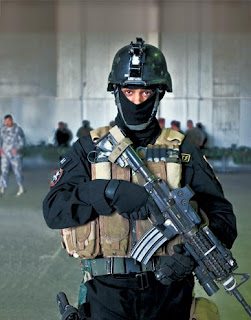
At first he couldn't tell whether the men were Iraqis or Americans. He says he identified himself as a police sergeant, offering his ID before they took his pistol and knocked him to the ground. The men didn't move like any Iraqi forces he'd ever seen. They looked and spoke like his countrymen, but they were wearing American-style uniforms and carrying American weapons with night-vision scopes. They accused him of being a commander in the local militia, the Mahdi Army, before they dragged him off, telling his wife he was "finished." But before they left, they identified themselves. "We are the Special Forces. The dirty brigade," Hassan recalls them saying.

The Iraq Special Operations Forces (ISOF) is probably the largest special forces outfit ever built by the United States, and it is free of many of the controls that most governments employ to rein in such lethal forces. The project started in the deserts of Jordan just after the Americans took Baghdad in April 2003. There, the US Army's Special Forces, or Green Berets, trained mostly 18-year-old Iraqis with no prior military experience. The resulting brigade was a Green Beret's dream come true: a deadly, elite, covert unit, fully fitted with American equipment, that would operate for years under US command and be unaccountable to Iraqi ministries and the normal political process.

According to Congressional records, the ISOF has grown into nine battalions, which extend to four regional "commando bases" across Iraq. By December, each will be complete with its own "intelligence infusion cell," which will operate independently of Iraq's other intelligence networks. The ISOF is at least 4,564 operatives strong, making it approximately the size of the US Army's own Special Forces in Iraq. Congressional records indicate that there are plans to double the ISOF over the next "several years."

According to retired Lt. Col. Roger Carstens, US Special Forces are "building the most powerful force in the region." In 2008 Carstens, then a senior fellow at the Center for a New American Security, was an adviser to the Iraqi National Counter-Terror Force, where he helped set up the Iraqi counterterrorism laws that govern the ISOF.

"All these guys want to do is go out and kill bad guys all day," he says, laughing. "These guys are shit hot. They are just as good as we are. We trained 'em. They are just like us. They use the same weapons. They walk like Americans."

When the US Special Forces began the slow transfer of the ISOF to Iraqi control in April 2007, they didn't put it under the command of the Defense Ministry or the Interior Ministry, bodies that normally control similar special forces the world over. Instead, the Americans pressured the Iraqi government to create a new minister-level office called the Counter-Terrorism Bureau. Established by a directive from Iraq's prime minister, Nuri al-Maliki, the CTB answers directly to him and commands the ISOF independently of the police and army. According to Maliki's directive, the Iraqi Parliament has no influence over the ISOF and knows little about its mission. US Special Forces operatives like Carstens have largely overseen the bureau. Carstens says this independent chain of command "might be the perfect structure" for counterterrorism worldwide.

Although the force is officially controlled by the Iraqi government, popular perception in Baghdad is that the ISOF--the dirty brigade--is a covert, all-Iraqi branch of the US military. That reading isn't far from the truth. The US Special Forces are still closely involved with every level of the ISOF, from planning and carrying out missions to deciding tactics and creating policy. According to Brig. Gen. Simeon Trombitas, commander of the Iraq National Counter-Terror Force Transition Team, part of the multinational command responsible for turning control of the ISOF over to the Iraqi government, the US Special Forces continue to "have advisers at every level of the chain of command."

In January 2008 the US Special Forces started allowing ISOF commanders to join missions with them and the ISOF rank and file. Starting last summer--when Hassan's family was attacked--ISOF battalions began launching missions on their own, without American advisers, in Sadr City, where political agreements forbid the Americans from entering. Accusations of human rights abuses, killings and politically motivated arrests have surfaced, including assaults on a university president and arrests of opposition politicians.

The US government has been focused on turning out "as many men in arms as possible, as quickly as possible," says Peter Harling, senior Middle East analyst at the International Crisis Group. "There has been very little impetus to build checks and controls to prevent abuse. It's been very much about building up capability without the oversight that could prevent some of the units [from] turning into proxies working for some politician."

In Sadr City opposition to the Iraqi government and the US occupation is strong. There is no longer any visible militia presence, but pictures of anti-American cleric Muqtada al-Sadr still stick to the US-built concrete walls that enclose the city, and calls to prayer end with a demand for the hastened exit of "the enemy." There, the ISOF uses a policy of collective punishment, aimed at intimidating civilians, charges Hassan al-Rubaie, Sadrist member of the parliamentary Security and Defense Committee. "They terrorize entire neighborhoods just to arrest one person they think is a terrorist," he says. "This needs to stop."

US Special Forces advisers have done little to respond to allegations of abuse. Civilian pleas, public protests, complaints by Iraqi Army commanders about the ISOF's actions and calls for disbanding it by members of Parliament have not pushed the US government to take a hard look at the force they are creating. Instead, US advisers dismiss such claims as politically motivated. "The enemy is trying to discredit them," says Carstens. "It's not because they are doing anything dirty."

On the same night Hassan Mahsan's house was raided, 26-year-old Haidar al-Aibi was killed with a bullet to the forehead. His family says there was no warning. They tell me how it happened as we drink tea on the floor of their living room, furnished only with thick foam cushions and mournful depictions of the Shiite martyr Hussein. A woman weeps loudly in the corner, the sleeping child of her dead son almost obscured by the folds of her black garments.

Fathil al-Aibi says the family was awakened around midnight by a nearby explosion. His brother Haidar ran up to the roof to see what had happened and was immediately shot from a nearby rooftop. When Fathil, his brother Hussein and his father, Abbas, tried to bring Haidar downstairs, they were shot at, too. For about two hours he lay lifeless on the roof while his family panicked as red laser beams from rifle scopes danced on their windows. "We had tests the next day at the university," Hussein says. "We didn't think he would go like this."

Down the road, around the same time that night, police commando Ahmed Shibli says he was also being fired on. He illuminates two bullet holes in his house with a kerosene lamp as we talk. The men who busted open his front door called themselves the dirty brigade, he says, and they were carrying American weapons, not the AK-47s or PKCs the National Police use. When they entered, they fired immediately. "It wasn't a warning shot. They shot at me like they wanted to kill me as I was getting down on the ground. It was like we were first-degree terrorists." They fired again, he says, fatally shooting his ailing 63-year-old father. As blood poured from the old man's hip, Ahmed says the men held a gun to his little boy's head and forced his wife to search the room for the police-issued weapon he had left at work.

Ahmed and his brother were hauled to the outskirts of the city, along with Hassan, where they were lined up with other men in the dark. Hassan insists on substantiating his story by showing me an official complaint issued by a local army commander named Mustafa Sabah Yunis, alleging that an "unknown armed squadron" entered the area and arrested him.

Meanwhile, the Iraqi Army was rushing in to respond to the gunfire, and according to Hussein al-Aibi, these soldiers were shot at as well. He tells me the army got Haidar off the roof and drove him to the hospital. On the way, Fathil says, the vehicle was stopped by a dirty brigade operative, who asked Iraqi Army Major Abu Rajdi where they were going. According to Fathil, Rajdi told the operative, "This is a college student who has nothing to do with anything, and you shot him recklessly." The operative responded by hitting Rajdi and saying, "Turn around and go back, or we'll shoot him and we'll shoot you too."

At Haidar's funeral, Fathil asked Rajdi to testify. "You are a representative of the government, and you saw it all happen," he told the major. "You saw that he didn't have a weapon in his hand." Fathil says the major declined. "This is the dirty brigade," he recalls Rajdi saying. "We are afraid of them. When we see them, we retreat. If I testify against them, I'll be killed the next day. They kill and no one will hold them accountable, because they belong to the Americans."

Major Rajdi's fear and distrust of the ISOF are echoed by other members of the regular Iraqi Army. "Sometimes we are surprised when the Special Forces enter," says Lt. Colonel Yahya Rasoul Abdullah, commander of the Third Battalion of the Forty-second Brigade in Sadr City. "Bad things happen. Some people steal, and some abuse women. They don't know the people on the streets like us. They just go after their target. We have suffered from this problem."

Accounts of older ISOF operations I heard around Baghdad suggest that the Americans may have knowingly allowed violence against civilians. In Adhamiya, long the stronghold of the Sunni insurgency in Baghdad, two hospital employees described their 2006 run-in with the ISOF to me. According to both witnesses, a self-identified ISOF operative named "Captain Hussam" unloaded his machine gun in the Al Numan Hospital after seeing the body of his superior, who had died under the hospital's care. An American operative with a red beard stood by silently watching. According to one witness, the Iraqi operative demanded his commander's death certificate, threatening to "torture you, kill you and kill the people of Adhamiya" if they didn't comply. The witnesses said the eight operatives who entered the hospital were driving Humvees, vehicles that only the Americans and the ISOF use. The next day, Captain Hussam returned, a witness said, offering a box of bullets as
an apology.

The effective head of the American ISOF project is General Trombitas of the Iraq National Counter-Terror Transition Team. A towering man with a gray mustache and a wrinkled brow, Trombitas spent nearly seven of his over thirty years in the military training special forces in Colombia, El Salvador and other countries. On February 23 he gave me a tour of Area IV, a joint American-Iraqi base near the Baghdad International Airport, where US Special Forces train the ISOF. As we walk away from the helicopter, he cracks a boyish smile. Though he's worked with special forces all over the world, he tells me the men we are about to meet are "the best."

Trombitas says he is "very proud of what was done in El Salvador" but avoids the fact that special forces trained there by the United States in the early 1980s were responsible for the formation of death squads that killed more than 50,000 civilians thought to be sympathetic with leftist guerrillas. Guatemala was a similar case. Some Guatemalan special forces that had been trained in anti-terrorism tactics by the United States during the mid-1960s subsequently became death squads that took part in the killing of around 140,000 people. In the early 1990s, US Special Forces trained and worked closely with an elite Colombian police unit strongly suspected of carrying out some of the murders attributed to Los Pepes, a death squad that became the backbone of the country's current paramilitary organization. (Trombitas served in El Salvador from 1989-90 and in Colombia from 2003-2005, after these incidents took place.)

"The standards get looser when the Americans aren't with [the local special forces], and they can eventually become death squads, which I believe actually happened in Colombia," says Mark Bowden, author of Black Hawk Down and Killing Pablo, a book about the hunt for Colombian drug lord Pablo Escobar by CIA and US Special Forces. The tactics taught in each country are the same, Bowden says. "They teach the same kind of skills. They use the same equipment."

Trombitas told the official blog of the Defense Department that the training missions used in Latin America are "extremely transferable" to Iraq. Salvadoran Special Forces even helped train the ISOF, he tells me. "It's a world of coalitions," he says. "The longer we work together, the more alike we are. When we share our values and our experiences with other armies, we make them the same."

Trombitas guides me into a warehouse where ISOF operatives, most of them in black masks, have been preparing for our arrival. He walks me through a special display of their American equipment--machine guns, sniper rifles, state-of-the-art night-vision equipment and fluffy desert camo that makes soldiers look like teddy bears. He takes me up a catwalk overlooking a fake house stocked with cartoonish posters of big-breasted women pointing pistols, a couple of real men dressed as "terrorists" with kaffiyehs wrapped around their faces and a 10-year-old boy playing hostage.

As we stand in the observation area, the door explodes. After a minute of constant shooting, the operatives march out with the "terrorists," the boy and a poster of an '80s-style villain, wearing a jean jacket and holding a woman hostage. More than twenty bullet holes are centered on his forehead. "Look at that marksmanship," Trombitas says, smiling proudly.

Trombitas gets to the issue of human rights before I do. He assures me that US Special Forces take allegations of human rights abuses very seriously--two Iraqi men were let go for prisoner abuse since he took over in August last year, he says--but he won't comment on specific cases. I raise the issue of accountability and bring up one well-documented mission that caused waves in the Iraqi Parliament: in August the ISOF raided Diyala's provincial government compound, reportedly with the support of US Apache helicopters. They arrested a member of the Iraqi Islamic Party, Iraq's main Sunni Arab party. They also arrested the president of the university, also a Sunni, and killed a secretary and wounded four armed guards during the night.

I barely get the word "Diyala" out of my mouth before the American operatives standing around us start to grumble nervously and a translator jumps in. "For the reputation of the ISOF, please, let's cut that off," he says.

Abdul-Karim al-Samarrai, a member of the ruling United Iraqi Alliance and the parliamentary Security and Defense Committee, says that what happened in Diyala was one of many signs of the prime minister's bad intentions for the ISOF. "Politicians are afraid because this force can be used for political ends," he says. In response to outrage from members of Parliament over the arrest of politicians by the ISOF, Maliki, who is officially required to approve every ISOF target, denied any knowledge of the Diyala mission. His claim of innocence raises important questions. If the man who is supposed to be in charge of the ISOF has no knowledge of its missions, then who is ultimately responsible for the force? Was Maliki lying to cover up the fact that he is using the force for political purposes? Or was someone else--namely the Americans--calling the shots?

Diyala was only the first publicized case of possibly politically motivated arrests. In December the ISOF arrested as many as thirty-five officials in the Interior Ministry who were thought to be in opposition to Maliki's Islamic Dawa Party. This past March the ISOF arrested at least one leader of the Awakening Councils, semiofficial Sunni neighborhood militias that have been increasingly at odds with Maliki over his failure to keep a promise to incorporate the councils into the military or give them other employment.

The Maliki government has developed a "culture of direct control," says Michael Knights, a Lafer Fellow at the Washington Institute and the head of its Iraq program. Knights visits Iraq regularly and has close contact with the country's security services. He says the people in charge of the ISOF at the regional levels are "personally chosen loyalists or relatives of Maliki. It reminds me of Saddam." Knights says that Maliki is only supposed to approve or reject missions that come to him, but occasionally he will "assert his prerogative as the commander in chief and tell the ISOF to do something or not to do something." Knights raises the possibility that the ISOF will become Maliki's personal death squad. "The prime minister is looking for re-election, and there are not that many restraints on his ability to target political opponents, as [his government] has been doing with the Sadrists for years now."

Samarrai, along with other members of Parliament, is calling for disbanding the Counter-Terrorism Bureau. He says there is no legal basis for an armed brigade to exist outside the control of the Interior or Defense ministry. "People are afraid of the existence of an organization with such dreadful capabilities that reports directly to the prime minister," he says.

Member of Parliament Hassan al-Rubaie is concerned about the close relationship between the ISOF and the Americans. "If the US leaves Iraq, this will be the last force they will leave behind," he insists. He is worried that such a powerful and secretive force that is closely tied to the Americans could turn Iraq into a "military base in the region" by allowing the United States to continue to conduct missions in Iraq with the cover of the ISOF. "They have become a replacement" for the Americans, he says.

President Obama has said he plans to increase reliance on the US Special Forces; Defense Secretary Robert Gates's recent appointment of Stanley McChrystal as commander of Afghanistan suggests that he is keeping his word. From 2003 to 2008, McChrystal was the head of the Joint Special Operations Command, which oversees the Army's most secretive forces and is responsible for the training of special forces abroad. McChrystal was also commander of US Special Operations Forces in Iraq for five years, during which time, according to the Wall Street Journal, he commanded "units that specialize in guerrilla warfare, including the training of indigenous armies."

"The eventual drawdown in Iraq is not the end of the mission for our elite forces," Gates said in May 2008. Gates hasn't spoken on the issue since Obama took office; but Obama says he will institutionalize irregular warfare capabilities, and the White House stresses the need to "create a more robust capacity to train, equip and advise foreign security forces, so that local allies are better prepared to confront mutual threats."

Bowden says those "local allies" are often used for covert operations. "The United States Special Operations Command cultivates relationships with special forces in other countries because it gives the United States the opportunity of intervening militarily in a covert way," he says. "The ideal covert op is one that is actually carried out by local forces."

As I stand on the tarmac with Trombitas in Area IV, waiting for our helicopter to return and fly us back to the Green Zone, I ask him how long the United States will be involved with the ISOF. "Special forces are special because we do maintain a relationship with foreign forces," he says. "Part of our theater-engagement strategy is to maintain a relationship with those units that are important to the security of the region and to the world." As our helicopter appears in the lightly clouded sky, he chooses his next words carefully: "We are going to have a working relationship for a while," he says.

Canadian, U.S., U.K. life, health insurers investing heavily in tobacco companies

.....

Canadian firm Sun Life has $1 billion in two companies

June 5, 2009 - Agence France-Presse

.....

Major U.S., Canadian and British life and health insurance companies have billions of dollars invested in tobacco companies, says a study published in the New England Journal of Medicine.

Wesley Boyd, the study's lead author, found that at least $4.4 billion US in insurance company funds are invested in companies whose affiliates produce cigarettes, cigars and chewing tobacco.

"Despite calls upon the insurance industry to get out of the tobacco business by physicians and others, insurers continue to put their profits above people's health," said Boyd, a faculty member of Harvard Medical School.

"It's clear their top priority is making money, not safeguarding people's well-being," he wrote.

Tobacco is considered the leading cause of lung cancer and a major risk factor for heart attack, stroke, pulmonary disease and cancer.

According to the World Health Organization, it is a contributing factor in 5.4 million deaths a year.

Researchers first revealed that health and life insurance companies had major investments in tobacco companies in 1995 in an article in the British medical journal Lancet.

"Although investing in tobacco while selling life or health insurance may seem self-defeating, insurance firms have figured out ways to profit from both," Boyd wrote.

"Insurers exclude smokers from coverage or, more commonly, charge them higher premiums. Insurers profit -- and smokers lose -- twice over."

According to the study, U.S. insurer Prudential Financial Inc. has $264.3 million invested among three U.S. tobacco companies, including Reynolds America and Philip Morris.

Canadian insurer Sun Life Financial Inc., which sells life, disability and health insurance, has a stock portfolio with more than $1 billion in two tobacco companies, including $890 million in Philip Morris.

Prudential Plc, which sells health and disability insurance, has $1.38 billion in two tobacco companies, including British American Tobacco.

The study also details the substantial tobacco investments of the U.S. firms Northwestern Mutual and Massachusetts Mutual Life, and the Scottish firm Standard Life Plc.

Subs Surface as Key Tool of Drug Cartels

This 60-foot semi-submersible at the Coast Guard base in Key West, Fla., was captured by a U.S. drug interdiction task force. It carried 6.4 tons of cocaine. (By William Booth -- The Washington Post)

.....

William Booth and Juan Forero
June 6, 2009 - Washington Post

.....

Now U.S. law enforcement officials say that more than a third of the cocaine smuggled into the United States from Colombia travels in submersibles.

An experimental oddity just two years ago, these strange semi-submarines are the cutting edge of drug trafficking today. They ferry hundreds of tons of cocaine for powerful Mexican cartels that are taking over the Pacific Ocean route for most northbound shipments, according to the Colombian navy.

The sub-builders are even trying to develop a remote-controlled model, officials say.

"That means no crew. That means just cocaine, or whatever, inside the boat," said Michael Braun, a former chief of operations at the U.S. Drug Enforcement Administration.

The subs are powered by ordinary diesel engines and built of simple fiberglass in clandestine shipyards in the Colombian jungle. U.S. officials expect 70 or more to be launched this year with a potential cargo capacity of 380 tons of cocaine, worth billions of dollars in the United States.

"This is definitely the next generation of smuggling conveyance," said Joseph Ruddy, an assistant U.S. attorney in Tampa who prosecutes narco-mariners.

The submersibles are equipped with technologies that make them difficult to intercept, even though U.S. forces use state-of-the-art submarine warfare strategies against them. Authorities say most slip through their net.

"You try finding a floating log in the middle of the Pacific," one DEA agent said.

U.S. officials and their Colombian counterparts have detected evidence of more than 115 submersible voyages since 2006. They have apprehended the crews of more than 22 submersibles at sea since 2007. Six crews have been arrested this year. The Colombian navy has intercepted or discovered 33 subs since 1993.


U.S. officials fear that the rogue vessels could be used by terrorists intent on reaching the United States with deadly cargos.

Daytime Drift

The vessels do not fully submerge but skim the sea surface. They move quickly at night, then drift like sleeping whales during the day. Under cover of darkness, they slither out of Colombia's shallow rivers and 10 days later rendezvous offshore along the Central American coast, usually near Guatemala, where cocaine is offloaded and the subs are sunk.

Smugglers first experimented with heavy steel subs dubbed "coffin ships" by the Colombians. Trial and error quickly advanced their capabilities.

"These vessels are intelligently designed. They are not very comfortable, but they are now very seaworthy. They are capable of carrying multi-ton cargos. They can travel thousands of miles without refuel or resupply. And they are very hard to detect," said U.S. Coast Guard Rear Adm. Joseph Nimmich, director of the Joint Interagency Task Force South, which pursues drug interdiction in the Caribbean and eastern Pacific Ocean.

Nimmich stood on a dock at the task force's headquarters in Key West, Fla., beside a vessel dubbed Big Foot II. Captured last year 350 miles off the Guatemalan-Mexican coast, the sub had a four-man Colombian crew and 6.4 tons of cocaine aboard, worth more than $100 million.

Almost 60 feet long, the craft employed water-cooled exhaust mufflers to reduce its infrared heat signal. It was camouflaged in blue-gray paint. A small conning tower jutted from the deck at an angle designed to confuse radar signals.

The latest submersibles can go 3,000 miles without refueling.

"You don't want to see one of these trekking up the Hudson River," Ruddy said.

Officials estimate that the subs cost about $1 million to manufacture in Colombia. Colombian officials say some former military personnel might be helping to design, construct and direct the vessels.

Colombian navy Adm. Guillermo Barrera said the subs usually carry 4 to 10 tons of cocaine. They typically have a crew of four -- including a captain, an engineer and a seaman, known as "braceros," or "arms," who help steer and unload the cocaine. The fourth crew member is usually a representative of the owner. With cargos worth $100 million or more, "you want to know where they're headed," Barrera said.

According to officials, crews are well compensated, splitting as much as $500,000. The work is dangerous; the subs cross stormy sea lanes without lights, with a shifting ballast of fuel and drugs. The cabins are hot and cramped, with a bucket for a latrine and a floor to sleep on.

U.S. officials say submersibles are escorted by countersurveillance vessels, disguised as fishing trawlers, that warn them of nearby navy cutters or spotter planes. Nimmich said the sub crews use radios infrequently and speak in code. Until recently, submariners caught by authorities could not be charged in the United States or Colombia if the cocaine was scuttled.

"The vessels are built to sink. When they open the valves, tons of water come in, and in a minute, or a minute and a half, they sink," Barrera said. "There is no evidence, and what starts as a counterdrug operation becomes a rescue operation."

U.S. and Colombian agents have been frustrated in this cat-and-mouse game. "With no drugs found, we couldn't prosecute," said Ruddy, the assistant U.S. attorney. At least eight crews have been returned to Colombia after rescue, without being charged.

In response, last fall the U.S. Congress passed the Drug Trafficking Vessel Interdiction Act of 2008, which makes it a crime to ply international waters in stateless vessels with the intent of evading detection. The maximum sentence is 15 years. So far, three crews have either entered pleas or been found guilty under the new statute. Colombia has responded with a similar law that awaits final approval.

Accused Builder


Last August, Colombian authorities arrested Gustavo Adolfo de Jesús García, alias "The Engineer," the alleged mastermind of a sub-building syndicate, and Lope Antonio López, known as "El Gringo," accused of brokering deals with Mexican cartels eager to move tons of cocaine to Mexico via submersibles.

García and López, authorities said, were focused on the manufacturing side of the business, building bigger, stealthier, sleeker vessels. Colombian police say the men were also offering something new -- drone subs operated by remote control.

In a recent telephone interview with The Washington Post, López said from a prison in Colombia that he had nothing to do with the submarine network. But he shed light on how the boat-building enterprise might work.

López said that in 2007 he was selling fishing boats to Venezuela's government. As part of the job, he headed to Panama City to purchase diesel engines. While there, a friend suggested that he have lunch with a man with Mexican clients. At the lunch, the man asked López to build semi-submersibles. "They look for someone who could do the fiberglass construction," López said.

López insisted he walked out of the meeting when he realized it was about drug trafficking. He was extradited to the United States on drug trafficking charges in May.

Saturday, June 6, 2009

Texans Sue KBR, Halliburton Over War-Zone Burn Pits

.....

Guillermo Contreras
June 5, 2009 - San Antonio Express-News

.....

Six people from Texas, including some soldiers, who claim they were poisoned by toxins and emissions from burn pits at U.S. camps in Iraq and Afghanistan are suing contractors KBR and Halliburton.

The suit, moved to federal court in San Antonio from state court last week, alleges the companies operated the large war-zone pits and burned waste since 2004 that included trucks, tires, plastic water bottles, medical waste, hazardous materials, animal carcasses and even human corpses.

The suit claims burning the waste in open pits - with no safety controls - may have released toxins that harmed at least 100,000 people, including U.S. troops, contractors and civilians.

Lawyers for the plaintiffs are seeking to make the case a class-action lawsuit, citing evidence that many others are having symptoms or medical conditions that include severe respiratory ailments, asthma, sleep apnea, heart problems, tumors, lymphoma and leukemia.

Some even have died, according to the suit and news reports.

The situation has been likened by some observers to that caused by Agent Orange of the Vietnam era.

The suit was filed on behalf of Robert Cain of San Marcos; Craig Henry of San Antonio; Francis Jaeger of Haltom City; David McMenomy of Lampasas; Mark Posz of San Antonio; and El Kevin Sar of Houston.

The six exhibited symptoms ranging from acute abdominal pains, chronic respiratory infections, burning sensations in the lungs and persistent cold-like symptoms.

McMenomy had a football-size tumor removed from his hip suspected of being caused by fumes from a burn pit at Camp Al Taji, Iraq, the suit said.

The six couldn't be reached for comment Wednesday.

Lawyers with Burke O'Neill LLC in Washington have filed lawsuits in 10 states, including the one in San Antonio.

Thirty-four suits have been filed or are expected to be filed in 34 states where people with symptoms have surfaced, plaintiffs' attorney Elizabeth Burke said.

The burn pits are so large, the suit said, that tractors are used to push "every type of waste imaginable" into the fire, and the flames shoot hundreds of feet into the sky, sometimes around the clock.

The suit claims the contractors failed to install incinerators to limit the toxic exposure.

"They took an enormous amount of taxpayer dollars and did shoddy work," Burke said of the contractors. "The work they did harmed the soldiers and hindered the military mission. In some bases with an Air Force presence, planes could not take off and land because of the smoke."

Houston-based KBR said it operated within the rules and regulations set by the U.S. military.

"The general assertion that KBR knowingly harmed troops is unfounded as the safety and security of all KBR employees and those the company serves remains our top priority," said an e-mailed statement from KBR spokeswoman Heather Browne.

Halliburton, which at one time was the parent company of KBR and also is in Houston, questioned why it was named as a defendant.

"As these lawsuits are based on KBR activity in Iraq and Afghanistan, we believe that Halliburton is improperly named in these cases and, as such, we expect Halliburton to be dismissed from the suits as Halliburton would have no responsibility, legal or otherwise, for the actions alleged," Halliburton spokeswoman Diana Gabriel said by e-mail.

Senior members of military environmental health assessment teams have expressed concern about the pits to the Pentagon. One of them called the burn pit at Balad Air Base in Iraq "the worst environmental site I have personally visited" in 10 years.

In May, congressional lawmakers introduced a bill that would prohibit the military from operating burn pits in Iraq and Afghanistan for longer than six months and require the Pentagon to identify service members who already may have been exposed to toxins so they could be treated.

"Disturbing reports are coming to light every day about these burn pits and the toll they are taking on the health of many of our service men and women," said U.S. Rep. Tim Bishop, D-N.Y., who co-authored the bill with U.S. Rep. Carol Shea-Porter, D-N.H. "Our troops should be free to focus on fighting the enemy without worrying how their lives may be further endangered by the actions of private contractors operating under different rules."

Bishop and others set up a Web site - burnpits.org - with information and personal stories about burn pits.

An Air Force memo that was leaked recently on Wikileaks, a Web site that receives documents from anonymous sources to help expose government misdeeds, said thousands of people might have been exposed to toxins at a burn pit at Balad Air Base.

"In my professional opinion, the known carcinogens and respiratory sensitizers released into the atmosphere by the burn pit present both an acute and chronic health hazard to our troops and local population," Lt. Col. James R. Elliott, the chief of aero-medical services, wrote in a December 2006 memo.

The memo said the pit had been identified as a health concern for several years.

The claims against the defendants include negligence, battery, breach of duty to warn, intentional infliction of emotional distress and breach of contract.

The suit seeks compensatory damages for current and future medical expenses and punitive damages "in an amount sufficient to strip defendants of all of the revenue and profits earned from their pattern of constant, wanton and outrageous misconduct and callous disregard and utter indifference to the welfare of Americans serving and working in Iraq."

"KBR is still reviewing the recently filed suits," KBR said in its statement. "It should be noted, though, that KBR did not operate the burn pit at Balad in Iraq, as has been previously asserted. It should also be noted that any burn pit operated in Iraq or Afghanistan is done pursuant to Army guidelines and regulations."

Let's Get Down to the Essentials

.....

Jacques Attali
June 3, 2009 - L'Express

.....

Contrary to what they'd like us to believe, the crisis is deepening: in the United States, all deficits are growing; bank defaults are worsening, and, even though Wall Street is up, its value still remains 40 percent below what it was in October 2007. On top of that, within informed circles, everyone is murmuring that we should expect further tsunamis: on private real estate loans, credit cards and commercial property.

To respond to all that, the United States, in a huge bet, is investing money it doesn't have in cutting-edge sectors. And China, in an equally audacious bet, is abandoning all hope of a recovery in its exports to America and, in a gigantic recovery effort, is investing 20 percent of its GDP in domestic infrastructure. Europe, for its part, is not doing anything. Paralyzed by its history and its precautions, it prefers to believe that the crisis will sort itself out on its own. Having bet everything on a reform in global governance that the London comedy quite naturally did not produce, it now seems to expect that the market will pull a miracle cure out of its pocket. Deprived of bold leaders in Brussels, the Union is not providing itself with a single new resource, neither to protect its banks, nor to relaunch its cutting-edge sectors. Two thousand and eight and 2009 will remain the years of the European nadir. The Euro itself will not withstand such a
shock.

It's time for France to understand that at this rate, the worst is virtually certain: a dropping real estate market, production overcapacity in key sectors, a recession in 2009, 2010 and even 2011. Unemployment will exceed 3.5 million people; the budget deficit will reach, in spite of all the cosmetic steps taken, eight or even 10 percent of GDP, unless there is a massive increase in taxes, which will become more and more difficult to implement as the presidential elections approach. Scientific and technical elites will rebel or leave, disgusted by the revelation of the fortunes made in finance. We must confront a difficult reality and repeat this every day until people understand it: if the government does not act in a truly revolutionary manner, the recession is here for at least ten years, which will lead to a decoupling of Europe and France, left behind forever by the countries that will have understood the significance of the upheavals underway.

In consequence, to act means massively reviving industry through spending clearly targeted on sectors of the future: health, energy, agriculture, infrastructure, the environment, new materials, software, nanotechnologies, neurosciences, cutting-edge services and cultural industries. And, to accomplish that, significantly increasing the salaries of researchers, professors, doctors, engineers - that is, all those whose creativity provides for the country. To the detriment, if necessary, of the income and privileges enjoyed by those who manage, finance and divert them. To act also means provisionally accepting deficits targeted to finance this spending for the future. That means promoting new models for companies, models more concerned about the long term and closer to those of NGOs and public services. That means orienting finance towards risk-taking in long-term sectors and not toward profit for its own account.

It's not a new recovery plan that we need, but a true realization of cultural and political urgencies. And in particular, we need a radical reconsideration of the division of power between those who create and those who finance: a requirement, I repeat, for our survival.

Europe Agrees How to Open Door to Dozens of Guantánamo Detainees

.....

June 04, 2009 - The Guardian UK

.....

Brussels boosts Obama's plan to close detention camp.

Brussels - European countries yesterday agreed terms for taking in dozens of detainees from Guantánamo Bay, boosting President Barack Obama's plan to close the detention camp.

After months of division over whether and how up to 60 detainees could take up residence in Europe, EU interior ministers meeting in Luxembourg agreed security guidelines and a mechanism for sharing information on the detainees.

Agreement means that iIndividual EU states will now be able to accommodate detainees who have been cleared for release but cannot be repatriated for fear they will be killed, tortured or jailed. They could take in "several dozen" detainees, said Martin Pecina, the Czech interior minister, who chaired the meeting.

The US has long been seeking new homes for about 60 inmates, with Washington stepping up the pressure from January when Obama announced the closure in one of the first statements of his presidency. This called Europe's bluff, since it has long deplored Guantánamo and needed to demonstrate support for the new US administration with more than words. While Spain and Portugal led about eight of the EU's 27 countries keen to help the Americans, there was resistance from Germany, Austria, the Netherlands and Scandinavian countries alarmed about security risks and the ease with which immigrants can travel around the 25 EU states which share the border-free Schengen regime.

Individual countries were split between political leaders keen to show willing with Obama and security establishments worried about taking in the detainees. "The security people have had the upper hand, highlighting the risks involved," said Anthony Dworkin, counter-terrorism expert at the European Council for Foreign Relations. "They argued that Europe did not make this problem, so why should it bear the risks. "

Yesterday's deal leaves it up to individual countries to decide whether to take inmates. Those that do have to furnish all other EU governments with intelligence information on the proposed immigrant and take account of objections.

The Dutch, said diplomats, also insisted on being able to invoke national law to bar a freed inmate from travelling from one EU country to another, despite Schengen.

The Europeans expect several of the detainees cleared for release to go to the US, while the European green light for accepting detainees could also raise pressure on Canada and Australia to follow suit.

Germany, for example, has argued that US federal states' reluctance to take in inmates should mean that European countries are not required to accommodate them. The Americans are pressing Berlin to allow in many of the 17 Uighurs, Chinese Muslims, held at Guantánamo and cleared for release.

Britain believes it has "done its bit" and is reluctant to accept more inmates. Since Obama made his closure pledge, Britain has accepted one former UK resident. There is one more former UK residentstill at Guantánamo, but the Americans have made no request for his acceptance by Britain. Under the Bush administration, Britain accepted a further 13 British citizens or residents. Britain and Ireland are not part of the Schengen area that extends from Portugal to Poland."It's a significant agreement because it puts a collective European stamp, a set of standards, and recognises that the US is rethinking its counter-terrorism policy in line with international law," said Dworkin.

The Europeans and the Americans are now expected to coordinate their counter-terrorism strategies by issuing a joint statement next month, following which the Americans will ask specific countries to take in certain individuals and also supply intelligence on their cases. The Americans want the problem solved by next January.

The European governments said they took yesterday's decision to show support for Obama's "thorough review of US counter-terrorism policies consistent with the rule of law and international law".

California's Water Woes Threaten the Entire Country's Food Supply

.....

Nearly a third of the country's food supply comes from California, but drought there may be a catastrophe for farmers -- and the rest of us.

Scott Thill
June 6, 2009 - AlterNet

.....

What a difference an administration makes. Samuel Bodman, the previous secretary of energy under the Bush administration, spent his short term stumping for nuclear power plant construction, polluting the hell out of the Earth, profiting off global warming and trying to significantly downplay America's singular role in greenhouse-gas emissions.

The new one? Well, he's a doom prophet with a Ph.D.

"I don't think the American public has gripped in its gut what could happen. We're looking at a scenario where there's no more agriculture in California. I don't actually see how they can keep their cities going," Steven Chu told the Los Angeles Times in February, shortly after taking office in January. "I'm hoping that the American people will wake up," he added, just in case there was any confusion about the gravity of the situation.

That kind of apocalyptic foresight has made Chu a breath of fresh, dystopian air. For eight nearly insufferable years, the American public has had no shortage of political tools telling it everything is going to be all right, that the United States is the greatest country in the world, that reports of our impending environmental devastation have been greatly exaggerated, and so on. By contrast, Steven Chu is a Cassandra on a mission from reality. But few, especially in the state he singled out, feel like buying what he is selling.

"Dr. Chu is not a climate scientist," argued Jim Metropulos, senior advocate at Sierra Club's California chapter, echoing the same conditional given in the Los Angeles Times article in which Chu was quoted. "Obviously, he's versed on it, but he's taking an apocalyptic view. I think it's not sustainable in its current form. We rely on imported water to grow high-value crops, but maybe the agriculture we have today may not be the agriculture we have decades from now."

That's a big maybe.

Here are some not-so-fun facts: California's agricultural sector grows approximately one-third of the nation's food supply and is nourished by diverted rivers and streams filled yearly by runoff from its prodigious Sierra Nevada snowpack, as well as groundwater pumping and other less-reliable methods. That snowpack -- which once sparked the first, but not the last, water war that helped transform a semi-arid Los Angeles into an unsustainable oasis less populous than only New York City -- is disappearing fast. Hence Chu's worrisome prediction.

To make matters worse, a crushing drought, now well into its third year, has made simply everything problematic. In California's central valley, home to a majority of the state's agricultural output, farmers are leaving hundreds of thousands of acres fallow, and the resultant economic depression is having a domino effect that could cost California $1 billion to start and is causing residents of a one-time food powerhouse to go hungry.

In April, a series of spring showers and storms upped the snowpack to 80 percent of normal. At the beginning of May, it stumbled to 66 percent, compared to 72 percent the year before. Complicating that are recent federal directives mandating reductions of water deliveries to California farmers and urban users by 5 to 7 percent in hopes of preserving the Pacific Coast's salmon fishery, which is hovering, like the state's snowpack, on the brink of extinction.

"This federal biological opinion puts fish above the needs of millions of Californians," Gov. Arnold Schwarzenegger self-righteously fumed after the federal directive came down in June. His sound and fury is unjustified, but instructive.

"Sooner or later California is going to change how it uses water," explained Environmental Defense Fund officials Cynthia Koehler and Laura Harnish in the Huffington Post. "We can do it before we lose our fish, or after."

But these are short-term issues clouding, pardon the pun, an inevitably larger one. According to recent climate science, California is never going to get its regularly scheduled snowpack back. Which means that even well-intentioned conservation outreach programs and bad-faith battles over agricultural irrigation are missing the point.

Like other geographies once sustained by an uninterrupted supply of water, California is going dry. And when it dries up, so does its cities, its people and its future. Simply put, global warming, human-induced and otherwise, has significantly broadened the range of the tropical belt by a rate of 70 kilometers per decade. Southern California, like the Sahara Desert and Sahel savanna, is already subtropical in the summer. But with climate crisis expanding its reach, that subtropical heat could claim not just Northern California's snowpack, but even part of Washington's and Utah's bounties.

Game over. Right?

"We don't share Chu's assessment," asserted John Andrew, executive manager on climate change for the California Department of Water Resources. "The hazard here is that you are trying to predict the future. Even if you are as brilliant as Chu, you're pretty much guaranteed to be wrong."

Fair enough, one supposes. But then why does the DWR have its own internally generated climate models forecasting what Andrew claimed as a "25-40 percent reduction of the snowpack by midcentury," which is trying to predict the same future, albeit more optimistically?

"We came up with that by looking at climate models that were out there," Andrew explained, "and applying historic hydrologic data in the state. We looked at every snowpack study out there, and they shoot the range of projections. Some are as high as over 90 percent reduction by 2100. But if you look at the linear trend, then you wind up with a smaller reduciton. It's not good science to look at one study; what we really wanted to do was take a responsible look at all the data."

But a responsible look at the historical data, which has been mostly linear for a few hundred years, is inherently unreliable, given the exponential nature of global warming. Everything from glacial melt rates to the occurrence of so-called freak firestorms has been thrown into nonlinear chaos in the last few decades.

Carbon emissions have exceeded projections of the Nobel Prize-winning Intergovernmental Panel on Climate Change, while ocean and land sinks, which suck up and store CO2, have decreased in efficiency. A study completed by the National Oceanic and Atmospheric Administration and Columbia University has argued that the southwestern United States could be headed for permanent drought by 2050. Given that the IPCC has been historically conservative, even out-of-date in its nevertheless sobering projections, playing it safe on climatological modeling is beyond conservative. It's reckless.

"The modeling we used is uncertain," Andrew admitted, when pressed further on DWR's predictions. "I guess you could call it modeling. Historic data is going to be an inadequate indicator, but we still have to look at it."

True that; you have to look at everything. But when it comes time to offer a prediction, it's best to, like Chu, prepare for the worst and hope for the best.

In fact, if you shave 10 conservative percentage points off DWR's predictions, you arrive around where Chu explained you would. And that is when things come into finer focus. Instead of fighting over Pacific salmon and Central Valley cows, or junior and senior water rights, you are now fighting for survival.

As Chu explained, cities like Los Angeles will not have to think about why it can't hose off its driveways or take long showers; it will have to think about whether it is going to run out of water altogether.

"What are you going to say?" Metropolous asked rhetorically. " 'All you people have to move out and go elsewhere?' That's not going to fly. We're trying to promote things that are cost effective and pretty easy, like water conservation. It doesn't mean a radical change to the people's lifestyle, if we manage water better."

Well, that depends on the lifestyle. It was barely a decade ago that the governor of water-challenged California was giving a thumbs-up to Hummer in a photo-op. Now he's had an environmental deathbed conversion? Please.

The way California is currently wasting water -- on elaborate lawns in Beverly Hills, on cow death-camps in the San Joaquin Valley, on whatever -- it either doesn't know where its water comes from or simply doesn't care.

So any significant conservation initiative is going to be a challenge to the status quo, to say nothing of lifestyle. And when the water vapor truly hits the fan in 2100 or 2050, or even sooner, given the cross-your-fingers modeling of not just the DWR but also the IPCC, what alternatives will there be other than to pack up and leave?

Metropolous and Andrew and other well-intentioned enviros might balk, but I'll stick with the apocalyptic rants of a truth-telling Ph.D. nominated by Barack Obama to become the nation's chief brainiac on all things energy, thanks. And you should, too.